El modelo Mínimamente Restrictivo, Funcionalmente Eficaz (LIFE): Un nuevo marco para las prácticas éticas de entrenamiento animal ☆
The least inhibitive, functionally effective (LIFE) model: A new framework for ethical animal training practices ☆
Escuela de Ciencias Animales y Veterinarias, Universidad de Adelaida, Adelaida, Australia Meridional, Australia
School of Animal and Veterinary Sciences, University of Adelaide, Adelaide, South Australia, Australia
* Dirección para reimpresiones y correspondencia: Eduardo J. Fernandez, School of Animal and Veterinary Sciences, University of Adelaide, Adelaide, SA 5005, Australia.
Correo electrónico: eduardo.fernandez@adelaide.edu.au
* Address for reprints and correspondence: Eduardo J. Fernandez, School of Animal and Veterinary Sciences, University of Adelaide, Adelaide, SA 5005, Australia.
E-mail address: eduardo.fernandez@adelaide.edu.au
Resumen
Abstract
La ética de los procedimientos de entrenamiento animal ha experimentado cambios drásticos en las últimas décadas, con un movimiento hacia métodos de entrenamiento basados en recompensas. Estas prácticas de entrenamiento basadas en recompensas también han sido influenciadas directamente por las ciencias del comportamiento y del bienestar animal, incluidos sus resultados de investigación. En las últimas dos décadas, el modelo mínimamente intrusivo, mínimamente aversivo (LIMA) ha sido utilizado para describir los métodos de entrenamiento animal basados en recompensas. Sin embargo, desde su creación, el modelo LIMA presenta una serie de problemas que persisten hasta hoy, entre ellos: (a) falta de claridad en su terminología, (b) ambigüedad en los enfoques de entrenamiento deseados, y (c) una historia de justificación de métodos de entrenamiento aversivos. Por lo tanto, se propone un enfoque alternativo que especifica (1) el aumento de opciones mediante la reducción de la inhibición, (2) la importancia de la función conductual, y (3) la definición del éxito como algo más que simplemente ser eficaz. El resultado es el enfoque Mínimamente Restrictivo, Funcionalmente Eficaz (LIFE) para las prácticas éticas de entrenamiento animal. El modelo LIFE se analiza en términos de su conexión con la terminología establecida, los principios conductuales y las prácticas de entrenamiento, así como su capacidad para promover el bienestar óptimo de los animales bajo nuestro cuidado y en nuestras vidas.
The ethics of animal training procedures have seen dramatic changes in the last few decades, with a movement toward reward-based training methods. These reward-based training practices have also been directly impacted by the behavioral and animal welfare sciences, including their research outputs. In the last couple of decades, the least intrusive, minimally aversive (LIMA) model of animal training has been used to describe reward-based animal training methods. However, a number of problems were built into the creation of LIMA and continue to exist today, including (a) a lack of clarity in its terminology, (b) ambiguity in desired training approaches, and (c) a history of aversive training methods justification. An alternative approach is therefore proposed, and one that specifies (1) increasing choices by inhibiting less, (2) the importance of function, and (3) defining success as more than simply being effective. The result is the least inhibitive, functionally effective (LIFE) approach to ethical animal training methods. LIFE is discussed in terms of its connection to established terminology, behavioral principles, and training practices, as well as its ability to promote optimal welfare for the animals under our care and in our lives.
Introducción
Introduction
En las últimas décadas, hemos observado cambios importantes en la ética y la aplicación de las prácticas modernas de entrenamiento animal. Por ejemplo, hemos visto descripciones formalizadas de métodos de entrenamiento basados en recompensas o libres de coerción, incluidos planes detallados para aplicar dichos procedimientos (Millikan, 2012; Ziv, 2017; Todd, 2018). Los investigadores han examinado y comparado el uso de protocolos de entrenamiento basados en el refuerzo con los métodos de entrenamiento tradicionales que dependen de herramientas aversivas, como los collares eléctricos, donde los primeros generalmente superan a los segundos (Cooper et al., 2014; China et al., 2020; de Castro et al., 2020). Hemos visto demostraciones documentadas de la capacidad con la que los principios basados en recompensas pueden aplicarse para modificar el comportamiento animal de manera ética, confiable y voluntaria, incluso con animales exóticos en zoológicos (Grandin et al., 1995; Fernandez y Timberlake, 2008; Melfi et al., 2020).
In the last few decades, we have observed major changes in the ethics and application of modern animal training practices. For instance, we have seen formalized descriptions of reward-based or force-free training methods, including detailed plans to use such procedures (Millikan, 2012; Ziv, 2017; Todd, 2018). Researchers have examined and compared the use of reinforcement-based training protocols to traditional training methods that rely on aversive tools, such as shock collars, with the former more typically outperforming the latter (Cooper et al., 2014; China et al., 2020; de Castro et al., 2020). We have seen documented demonstrations of the ability with which reward-based principles can be applied to modify animal behavior ethically, reliably, and voluntarily, including with exotic animals in zoos (Grandin et al., 1995; Fernandez and Timberlake, 2008; Melfi et al., 2020).
Si bien han ocurrido cambios claros tanto en las prácticas como en la filosofía de los procedimientos modernos de entrenamiento animal, también han existido dos obstáculos importantes para el progreso continuo: (1) la resistencia de los entrenadores tradicionales o "equilibrados" que utilizan regularmente herramientas aversivas, y (2) la falta de un modelo coherente y conciso para detallar las características importantes de las prácticas éticas de entrenamiento animal. El primero es esperado, ya que la resistencia al cambio es un obstáculo común para cualquier modificación propuesta en cualquier campo. El segundo, sin embargo, puede generar problemas considerables, en particular si el modelo propuesto para describir algún enfoque filosófico no es lo suficientemente simple y claro para transmitir la información importante y necesaria (Popper, 1985; Refsgaard y Henriksen, 2004). Por lo tanto, una característica crítica para describir eficazmente los procedimientos modernos de entrenamiento animal y cambio de conducta debería ser un marco simple que conecte la teoría, la ciencia y la práctica. En otras palabras, el marco debería describir con precisión tanto cómo pensar como cómo ejecutar el entrenamiento animal ético.
While clear changes in both the practices and philosophy of modern animal training procedures have occurred, there have also been two major hurdles for continued progress: (1) resistance from traditional or "balanced" trainers that regularly rely on aversive tools, and (2) a lack of a coherent and concise model to detail the important features of ethical animal training practices. The former problem is expected, as resistance to change is a common obstacle for any proposed modification to any field. The latter, however, can create considerable problems, particularly if a proposed model to describe some philosophical approach is not simple and clear enough to convey the important and necessary information (Popper, 1985; Refsgaard and Henriksen, 2004). Therefore, a critical feature for effectively describing modern animal training and behavior change procedures should be a simple framework that connects theory, science, and practice. In other words, the framework should accurately detail both how to think about and do ethical animal training.
Este artículo presenta un nuevo modelo o enfoque para pensar en las prácticas éticas de entrenamiento animal. Esto se logra en tres secciones: (1) una breve historia del bienestar animal y el entrenamiento (es decir, características importantes sobre cómo llegamos al estado actual de la ética del entrenamiento animal), (2) una inspección crítica de uno de los enfoques más comunes utilizados para describir el entrenamiento libre de coerción: el modelo mínimamente intrusivo, mínimamente aversivo (LIMA), y (3) la premisa para un nuevo enfoque: el modelo Mínimamente Restrictivo, Funcionalmente Eficaz (LIFE) para el entrenamiento animal. El propósito principal de este artículo es detallar la filosofía que subyace al enfoque LIFE para las prácticas de entrenamiento, así como proporcionar un conjunto práctico de directrices para aplicar este marco conceptual.
This paper introduces a new model or approach for thinking about ethical animal training practices. This is accomplished in three sections: (1) a brief history of animal welfare and training (i.e., important features about how we arrived at the current animal training ethics state of affairs), (2) a critical inspection of one of the more common approaches used to describe force-free training: the least intrusive, minimally aversive (LIMA) model, and (3) the premise for a new approach: the least inhibitive, functionally effective (LIFE) framework for animal training. The primary purpose of this paper is to detail the philosophy behind the LIFE approach to training practices, as well as provide a practical set of guidelines for applying this conceptual framework.
Una breve historia del bienestar y el entrenamiento animal
A Brief History of Welfare and Training
En la siguiente sección, describo brevemente algunos de los eventos que contribuyeron a formar tanto el moderno movimiento de bienestar animal como el de entrenamiento libre de coerción. Otros artículos proporcionan información más detallada sobre la historia del bienestar animal (Broom, 2011; Patterson-Kane y Golab, 2013; Fernandez y McWhorter, 2023) y el entrenamiento animal (Ramirez, 2012; Fernandez y Martin, 2021; Fernandez, 2022). Además, la Figura 1 resume algunos puntos de intersección entre los principales eventos históricos del bienestar animal y el entrenamiento animal.
In the following section, I briefly describe some of the events that helped form both the modern animal welfare and force-free training movements. Other papers provide more detailed information on the history of animal welfare (Broom, 2011; Patterson-Kane and Golab, 2013; Fernandez and McWhorter, 2023) and animal training (Ramirez, 2012; Fernandez and Martin, 2021; Fernandez, 2022). In addition, Figure 1 outlines some of the intersection of major historical animal welfare and animal training events.
El bienestar animal puede entenderse como una forma de describir la calidad de vida medible de un animal vivo (Broom, 2011). El moderno movimiento de bienestar animal ha sido profundamente influenciado por dos eventos principales: (1) la creación del Modelo de las Cinco Libertades, y (2) la evolución de dicho modelo hacia el Modelo de los Cinco Dominios. El Modelo de las Cinco Libertades fue inicialmente inspirado por escritos como el de Harrison (2013) Animal Machines (publicado originalmente en 1964) y el Informe Brambell de 1965, y desarrollado posteriormente por el Consejo de Bienestar de los Animales de Granja (FAWC, 1979; McCulloch, 2013; McCausland, 2014). Si bien esto representó un avance significativo para el bienestar animal, el enfoque principal del Modelo de las Cinco Libertades era evitar las experiencias negativas, es decir, libertades de determinados eventos (Browning y Veit, 2021). Fue el posterior Modelo de los Cinco Dominios el que avanzó hacia la evaluación del bienestar basándose en indicadores positivos, incluyendo "una vida que valga la pena vivir" (Mellor y Reid, 1994; Mellor, 2016). El Modelo de los Cinco Dominios fue actualizado en 2020 para incluir la consideración de las interacciones humano-animal, lo cual incorpora necesariamente la forma en que gestionamos el comportamiento de los animales a través de las prácticas de entrenamiento (Mellor et al., 2020).
Animal welfare can be thought of as a way of describing a measurable quality of a living animal (Broom, 2011). The modern animal welfare movement has been greatly influenced by two major events: (1) the creation of the Five Freedoms Model, and (2) the progression of the Freedoms model to become the Five Domains model. The Five Freedoms model was initially inspired by writings such as Harrison's (2013) Animal Machines (originally published in 1964) and from the Brambell Report of 1965, and later developed by the Farm Animal Welfare Council (FAWC, 1979; McCulloch, 2013; McCausland, 2014). While this was a major step forward for the welfare of animals, the primary focus of the Five Freedoms model was on avoiding negative experiences, or freedoms "from" events (Browning and Veit, 2021). It was the latter Five Domains model that would move to assessing welfare based on positive indicators, including "a life worth living" (Mellor and Reid, 1994; Mellor, 2016). The Five Domains model was updated in 2020 to include consideration of human-animal interactions, which necessarily incorporates how we manage the behavior of animals through training practices (Mellor et al., 2020).
El entrenamiento animal puede definirse mediante los procedimientos de condicionamiento respondiente y operante utilizados para elicitar, evocar o emitir conductas (Fernandez, 2022). El moderno movimiento de entrenamiento animal también puede decirse que comenzó a partir de dos eventos principales: (1) el "descubrimiento" del moldeamiento por parte de Skinner (Skinner, 1951; Peterson, 2004), y (2) la creación del campo de la Psicología Aplicada Animal por Keller y Marian Breland (Breland y Breland, 1951; Fernandez y Martin, 2021). Ambos eventos estuvieron directamente vinculados al Proyecto Paloma, en el que entre 1940 y 1943, Skinner y los Breland entrenaron palomas para guiar bombas como parte del esfuerzo bélico (Skinner, 1960; Capshew, 1993). El Proyecto Paloma fue tan impactante que los Breland abandonaron sus estudios académicos para desarrollar carreras en el entrenamiento animal, lo que resultó en la creación de Animal Behavior Enterprises, IQ Zoo (una atracción turística de carretera en Hot Springs, Arkansas) y algunos de los primeros espectáculos de entrenamiento de delfines (Bailey y Gillaspy, 2005; Bihm et al., 2010; Gillaspy et al., 2014). Cruciales para los esfuerzos de entrenamiento de los Breland fueron sus demostraciones públicas de cómo el refuerzo positivo podía utilizarse para entrenar casi cualquier conducta. El movimiento para seleccionar las recompensas sobre los métodos de enseñanza y entrenamiento coercitivos se hizo más público gracias a los esfuerzos de una ex entrenadora de delfines, Karen Pryor, quien publicó uno de los libros más influyentes sobre principios del refuerzo hasta la fecha: Don't Shoot the Dog (Pryor, 1984). Del mismo modo, esta preferencia por el aprendizaje basado en recompensas también fue planteada en trabajos académicos como Coercion and Its Fallout de Sidman (1989). Tras el cambio de siglo, otros eventos históricos importantes incluyeron la creación de ClickerExpo por Pryor, una de las primeras conferencias para entrenadores de animales basados en recompensas, el artículo de Friedman (2008) sobre la evaluación de los métodos de entrenamiento más allá de la eficacia (véase la sección posterior sobre LIFE), y la creación del modelo LIMA por Lindsay (2005).
Animal training can be defined by respondent and operant conditioning procedures used to elicit, evoke, or emit behavior (Fernandez, 2022). The modern animal training movement can also be said to have started from two major events: (1) Skinner's "discovery" of shaping (Skinner, 1951; Peterson, 2004), and (2) the creation of a field of Applied Animal Psychology by Keller and Marian Breland (Breland and Breland, 1951; Fernandez and Martin, 2021). Both of these events were directly connected to Project Pigeon, where between 1940 and 1943, Skinner and the Brelands trained pigeons to guide bombs as part of the war effort (Skinner, 1960; Capshew, 1993). Project Pigeon was so impactful that the Brelands left their academic studies to pursue animal training careers, which resulted in the creation of Animal Behavior Enterprises, IQ Zoo (a roadside tourist attraction in Hot Springs, Arkansas), and some of the first dolphin training shows (Bailey and Gillaspy, 2005; Bihm et al., 2010; Gillaspy et al., 2014). Critical to the Brelands training efforts were their public demonstrations of how positive reinforcement could be used to train almost any behavior. The movement to select rewards over coercive teaching and training methods was made more public through the efforts of an ex-dolphin trainer, Karen Pryor, who would publish one of the most influential books on reinforcement principles to date: Don't Shoot the Dog (Pryor, 1984). Similarly, this preference for reward-based learning was also put forward in academic works such as Sidman's (1989) Coercion and Its Fallout. Following the turn of the century, other major historical events included Pryor's creation of ClickerExpo, one of the first conferences for reward-based animal trainers, Friedman's (2008) article on assessing training methods beyond being effective (see later LIFE section), and Lindsay's (2005) creation of the LIMA model.
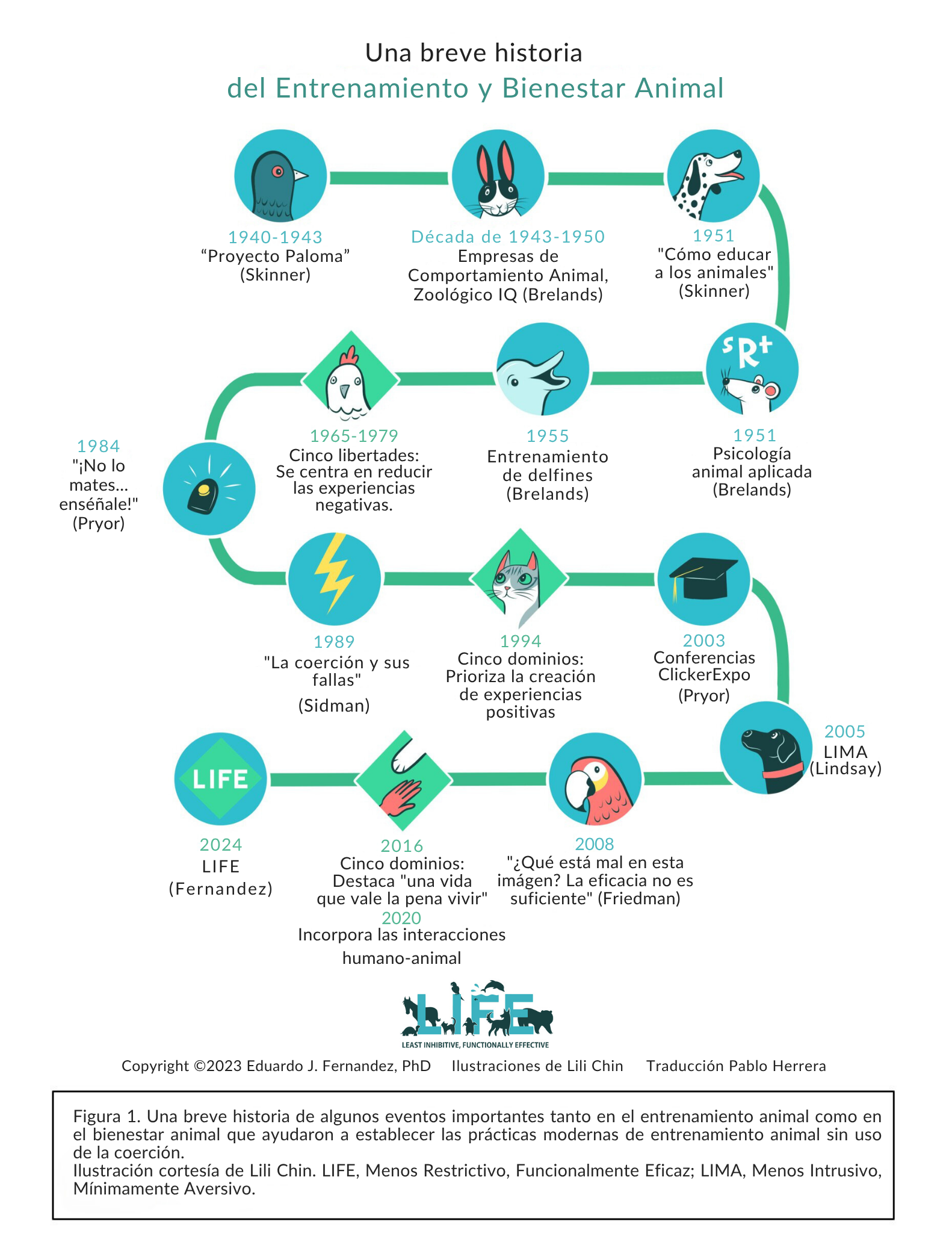
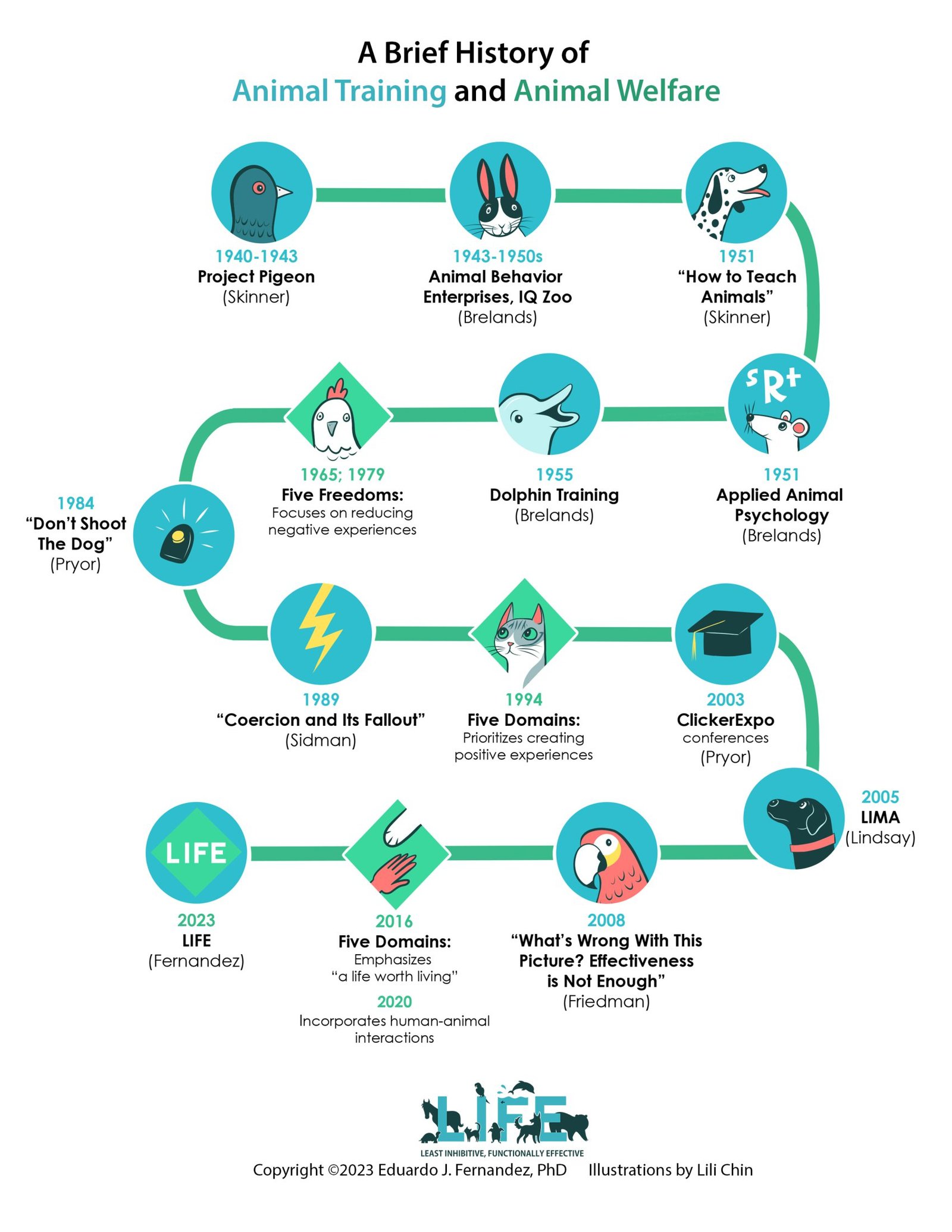
Figura 1. Una breve historia de algunos de los eventos importantes tanto en el entrenamiento animal como en el bienestar animal que contribuyeron a establecer las prácticas modernas de entrenamiento animal libre de coerción. Ilustración cortesía de Lili Chin. LIFE, Mínimamente Restrictivo, Funcionalmente Eficaz; LIMA, mínimamente intrusivo, mínimamente aversivo.
Figure 1. A brief history of some of the important events in both animal training and animal welfare that helped establish modern force-free animal training practices. Illustration courtesy of Lili Chin. LIFE, least inhibitive, functionally effective; LIMA, least intrusive, minimally aversive.
El Modelo Mínimamente Intrusivo, Mínimamente Aversivo
The Least Intrusive, Minimally Aversive Model
El modelo LIMA fue descrito por primera vez en el tercer volumen del Handbook of Applied Dog Behavior and Training de Lindsay (2005). En los últimos 18 años, LIMA se ha convertido en una de las formas más comunes con las que los entrenadores libres de coerción describen sus prácticas de entrenamiento. Además, LIMA ha sido utilizado para describir códigos de ética, estándares de la industria, declaraciones de posición y estándares de práctica por parte de organizaciones de entrenamiento conjuntas, que incluyen la Association for Pet Dog Trainers (APDT, 2017), el Certification Council for Pet Dog Trainers (CCPDT, 2019), la International Association for Animal Behavior Consultants (IAABC, s.f.) y la Karen Pryor Academy (KPA, 2019). LIMA ha llegado, por lo tanto, a representar un enfoque amplio de métodos de entrenamiento que minimizan, si es que no evitan por completo, el uso de herramientas de entrenamiento aversivas, lo que incluiría collares eléctricos, de estrangulamiento y de púas utilizados en el entrenamiento de perros (Fernandes et al., 2017; Ziv, 2017; Todd, 2018; Lattal y Fernandez, 2022). Si bien LIMA ha resultado útil como un medio simple para describir en términos generales una filosofía de entrenamiento libre de coerción, existen varias preocupaciones con este enfoque, entre ellas: (1) falta de claridad en la terminología utilizada, (2) ambigüedad en los enfoques de entrenamiento deseados, y (3) una historia de justificación de métodos de entrenamiento aversivos.
LIMA was first described in Lindsay's (2005) third volume of his Handbook of Applied Dog Behavior and Training series. Over the last 18 years, LIMA has become one of the most commonly used ways for force-free trainers to describe their training practices. In addition, LIMA has been used to describe codes of ethics, industry standards, position statements, and standards of practice by the joint standards of training organizations, which include the Association for Pet Dog Trainers (APDT, 2017), the Certification Council for Pet Dog Trainers (CCPDT, 2019), the International Association for Animal Behavior Consultants (IAABC, n.d.), and the Karen Pryor Academy (KPA, 2019). LIMA has therefore come to represent a broad approach of training methods that minimize, if not altogether avoid, the use of aversive training tools, which would include shock, choke, and prong collars used in dog training practices (Fernandes et al., 2017; Ziv, 2017; Todd, 2018; Lattal and Fernandez, 2022). While LIMA has proven useful as a simple means for generally describing a force-free training philosophy, there are several concerns with this approach, which include: (1) a lack of clarity in the terminology used, (2) ambiguity in desired training approaches, and (3) a history of justifying aversive training methods.
Falta de claridad en la terminología utilizada
Lack of clarity in the terminology used
Identificar los procedimientos como "mínimamente intrusivos" es un punto focal en los métodos de entrenamiento propios del modelo LIMA. Sin embargo, "intrusivo" es un término que nos dice poco sobre el efecto de cualquier evento en la conducta. Afirmar que algo es una intrusión o que irrumpe en un individuo no describe el impacto sobre cómo este responde de manera observable. Del mismo modo, decir que algún evento es intrusivo para la conducta aún nos dice prácticamente nada sobre cómo modifica dichas respuestas. En el mejor de los casos, "intrusivo" es un término que requiere una operacionalización adicional. Si bien algunos conductistas han utilizado el término "intrusivo" de manera procedimental (por ejemplo, véase Carter y Wheeler, 2005), sigue siendo problemático para describir cualquier efecto procedimental.
Identifying procedures as being "least intrusive" is a focal point for proper LIMA-based training methods. However, "intrusive" is a term that tells us little about the effect of any event on behavior. To say that something is an intrusion or intrudes on an individual does not describe the impact on how they overtly respond. Likewise, to say that some event is intrusive on behavior still tells us next to nothing on how it changes those responses. At best, "intrusive" is a term that requires additional operationalization. While a handful of behaviorists have used the term "intrusive" procedurally (for instance, see Carter and Wheeler, 2005), it is still problematic for describing any procedural effect.
Ambigüedad en los enfoques de entrenamiento deseados
Ambiguity in desired training approaches
El enfoque del modelo LIMA está en las prácticas que se deben limitar. Por ejemplo, aunque puede no ser claro qué efecto tiene lo "intrusivo", el acrónimo LIMA nos dice que debemos tener menos de ello. Del mismo modo, LIMA nos dice que seamos mínimos en nuestro enfoque de selección de métodos de entrenamiento. ¿Qué debemos hacer entonces? Durante más de medio siglo, las ciencias conductuales aplicadas han argumentado a favor de centrarse en lo que los individuos deberían hacer, no simplemente en lo que no deberían hacer (Winett y Winkler, 1972; Cooper et al., 2020). Al menos una parte de cualquier filosofía de entrenamiento libre de coerción debería centrarse en los criterios que debemos utilizar. En otras palabras, para ser un modelo de entrenamiento eficaz y conductualmente amigable, necesita informar qué prácticas y conductas seleccionar, no cuáles evitar.
The focus of the LIMA model is on practices to limit. For instance, while it may not be clear what effect "intrusive" has, the LIMA acronym tells us to have less of it. Likewise, LIMA tells us to be minimal in our training method selection approach. What, then, should we do instead? For over half a century, the applied behavioral sciences have argued in favor of focusing on what individuals should do, not simply what they should not do (Winett and Winkler, 1972; Cooper et al., 2020). At least part of any force-free training philosophy should focus on criteria we ought to use. In other words, to be an effective and behaviorally friendly training model, it needs to inform what practices and behaviors to select for, not against.
Historia de justificación de métodos de entrenamiento aversivos
History of aversive training methods justification
Uno de los mayores problemas del enfoque LIMA es la justificación que ha habilitado para el uso habitual de estímulos aversivos o métodos de entrenamiento coercitivos. Parte de esto es histórico, lo que se hace más evidente al remontarnos a las declaraciones originales de Lindsay. Por ejemplo:
One of the biggest problems for the LIMA approach is the justification it has enabled for regularly using aversive stimuli or coercive training methods. Some of this is historical, which becomes more evident as we go back to Lindsay's original statements. For instance:
"De acuerdo con el modelo mínimamente intrusivo y mínimamente aversivo (LIMA), los aversivos se clasifican en términos de su severidad e intrusividad relativas, requiriendo que el entrenador aplique una técnica menos aversiva antes de avanzar a una más aversiva." (p. 29)
"According to the least intrusive and minimally aversive (LIMA) model, aversives are ranked in terms of their relative severity and intrusiveness, requiring that the trainer apply a less aversive technique before advancing to a more aversive one." (p. 29)
Así, Lindsay estaba planteando un argumento a favor del uso de técnicas de entrenamiento coercitivas, y su manual incluye fotografías y descripciones de diversas herramientas de entrenamiento aversivas. Por ejemplo, en otra descripción, Lindsay afirma:
Thus, Lindsay was making an argument for the use of coercive training techniques, with his handbook providing pictures and descriptions of various aversive training tools. For example, in another description, Lindsay states:
"El uso correcto del collar de púas como herramienta de moldeamiento y perfeccionamiento requiere una instrucción significativa, pero con respecto a los usos básicos de control, los entrenadores novatos pueden dominar rápidamente el collar de púas." (p. 31)
"The proper use of the prong collar as a shaping and polishing tool requires significant instruction, but with respect to basic control uses novice trainers can rapidly master the prong collar." (p. 31)
Lo que queda claro en estas afirmaciones es que LIMA no fue concebido como un intento de minimizar el uso de estímulos aversivos, tal como muchos entrenadores modernos libres de coerción lo han conceptualizado. En cambio, Lindsay pretendía que LIMA fuera un marco para ayudar a los entrenadores a seleccionar sus estímulos y herramientas aversivas. Como concluye una de las últimas afirmaciones del manual:
What becomes clear in these statements is that LIMA was not intended to be an attempt to minimize the use of aversive stimuli, as many modern force-free trainers have conceptualized. Instead, Lindsay intended LIMA to be a framework to help trainers select their aversive stimuli and tools. As one of the latter statements in the handbook concludes:
"Los procedimientos aversivos son herramientas legítimas y valiosas para controlar el comportamiento indeseable…" (p. 725)
"Aversive procedures are legitimate and valuable tools for controlling undesirable behavior…" (p. 725)
Si bien LIMA ha sido una filosofía útil y simple para ayudar a identificar y describir un enfoque de entrenamiento animal basado en recompensas y libre de coerción, también tiene los inconvenientes antes mencionados. No obstante, estas críticas deben verse como formas de ayudar al campo del entrenamiento animal y a la filosofía del entrenamiento libre de coerción a avanzar. Todos los campos ajustan sus principios para progresar, y el progreso típicamente se logra identificando lo que debe hacerse a continuación. Por lo tanto, la sección siguiente detalla una posible nueva filosofía de entrenamiento libre de coerción.
While LIMA has been a useful, simple philosophy to help identify and describe a reward-based, force-free animal training approach, it also has the aforementioned drawbacks. Nonetheless, these criticisms should be viewed as ways to help the animal training field and force-free training philosophy move forward. All fields adjust their principles in order to advance, and progress is typically made by identification of what should be done next. Therefore, the section below details a potential new force-free training philosophy.
El Modelo Mínimamente Restrictivo, Funcionalmente Eficaz
The Least Inhibitive, Functionally Effective Model
Existen varios factores que cualquier descripción de un modelo de entrenamiento animal libre de coerción debería incorporar. Específicamente, estos deberían incluir el uso de terminología que sea representativa tanto de los métodos de entrenamiento actuales como de la ciencia que los sustenta, el reconocimiento de las prácticas de entrenamiento tanto deseadas como indeseadas, y la identificación de cómo definimos el éxito. Esto se aborda en tres partes: (1) aumentar la elección inhibiendo menos, (2) la importancia de la función, y (3) definir el éxito como algo más que ser eficaz. Los tres puntos deberían facilitar la conexión de las prácticas de entrenamiento y el modelo LIFE directamente con la teoría moderna del bienestar animal y la práctica basada en evidencia.
There are several factors that any description of a force-free animal training model should incorporate. Specifically, these should include using terminology that is both representative of current training methods and the science behind it, recognition of both desired and undesired training practices, and identification of how we define success. This is addressed in three parts: (1) increasing choice by inhibiting less, (2) the importance of function, and (3) defining success as more than being effective. All three points should facilitate connecting training practices and the LIFE model directly to modern animal welfare theory and evidence-based practice.
Aumentar la elección inhibiendo menos
Increasing choice by inhibiting less
Como se discutió anteriormente, el uso del término "intrusivo" nos dice poco sobre cómo cualquier método de entrenamiento afecta al animal objetivo o a su conducta. Históricamente, los conductistas han recurrido a dos términos para identificar algún tipo de impacto reductor sobre la conducta: (1) restricción, tal como se especifica en la alternativa menos restrictiva (Johnston y Sherman, 1993) o el principio de menor restricción (Vollmer et al., 2011), y (2) inhibición, tal como se detalla en el concepto de inhibición condicionada (Rescorla, 1969) y los estímulos/efectos restrictivos (Domjan, 2020). Ambos términos, si bien en abstracto solo nos indican que la conducta fue prevenida de alguna manera, también pueden informarnos sobre una reducción en las opciones disponibles y significativas. Nuestro objetivo, desde una perspectiva de bienestar, debería ser maximizar las opciones disponibles que sean beneficiosas para cualquier animal. Adicionalmente, los conductistas han utilizado un concepto similar en los "grados de libertad" (Goldiamond, 1976; de Fernandes y Dittrich, 2018) para identificar elecciones genuinas. El concepto de grados de libertad, presentado dentro del enfoque constructivo de Goldiamond (1974) (véase también Layng, 2009), puede describirse de manera más general como la especificación de la restricción o inhibición de los repertorios conductuales, ya sea mediante la falta de opciones (es decir, la ausencia de contingencias alternativas) o mediante la fuerza o la coerción. Podríamos igualmente proporcionar un entorno más restrictivo reduciendo las elecciones significativas (p. ej., restricción ambiental mediante aislamiento social o privación de alimentos) o mediante la aplicación de estímulos aversivos para forzar alguna(s) respuesta(s) (es decir, el uso de collares de estrangulamiento, de púas o eléctricos). Nótese que, en el primer ejemplo, un entrenador podría decir: "¡Pero yo solo uso refuerzo positivo!", aunque su práctica de entrenamiento puede ser inhibitoria a través de la restricción ambiental. La elección, el contexto y la función son partes igualmente importantes del modelo LIFE.
As discussed earlier, the use of the term "intrusive" tells us little about how any training method either affects the targeted animal or its behavior. Historically, behaviorists have relied on two terms to identify some type of reductive impact on behavior: (1) restriction, as specified in the least restrictive alternative (Johnston and Sherman, 1993) or the principle of least restrictiveness (Vollmer et al., 2011), and (2) inhibition, as detailed by the concept of conditioned inhibition (Rescorla, 1969) and inhibitory stimuli/effects (Domjan, 2020). Both terms, while abstractly tell us only that behavior was prevented in some way, can also inform us about a reduction in available and meaningful choices. Our goal, from a welfare perspective, should be to maximize available choices that are beneficial to any animal. Additionally, behaviorists have used a similar concept in "degrees of freedom" (Goldiamond, 1976; de Fernandes and Dittrich, 2018) to identify genuine choices. The concept of degrees of freedom, as presented within Goldiamond's (1974) constructional approach (see also Layng, 2009), can more generally be described as specifying the restriction or inhibition of behavioral repertoires, either through a lack of options (i.e., absence of alternative contingencies) or through force or coercion. We could equally provide a more inhibitive environment by reducing meaningful choices (e.g., environmental restriction through social isolation or food deprivation) or by applying aversive stimuli to force some response(s) (i.e., the use of choke, prong, or shock collars). Note that, in the first example, a trainer could say, "but I only use positive reinforcement!," even though their training practice may be inhibitive through environmental restriction. Choice, context, and function are all equally important parts of the LIFE model.
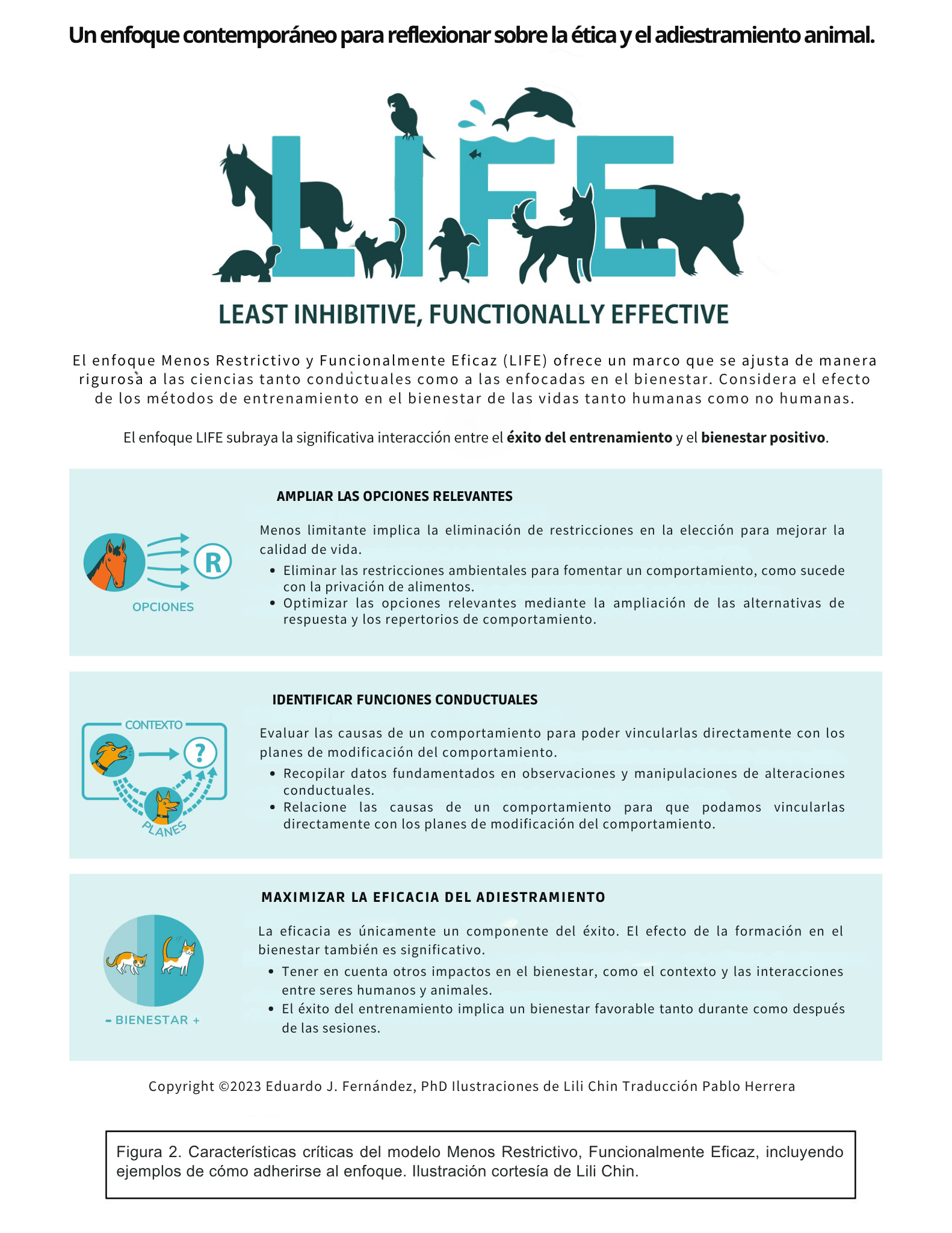
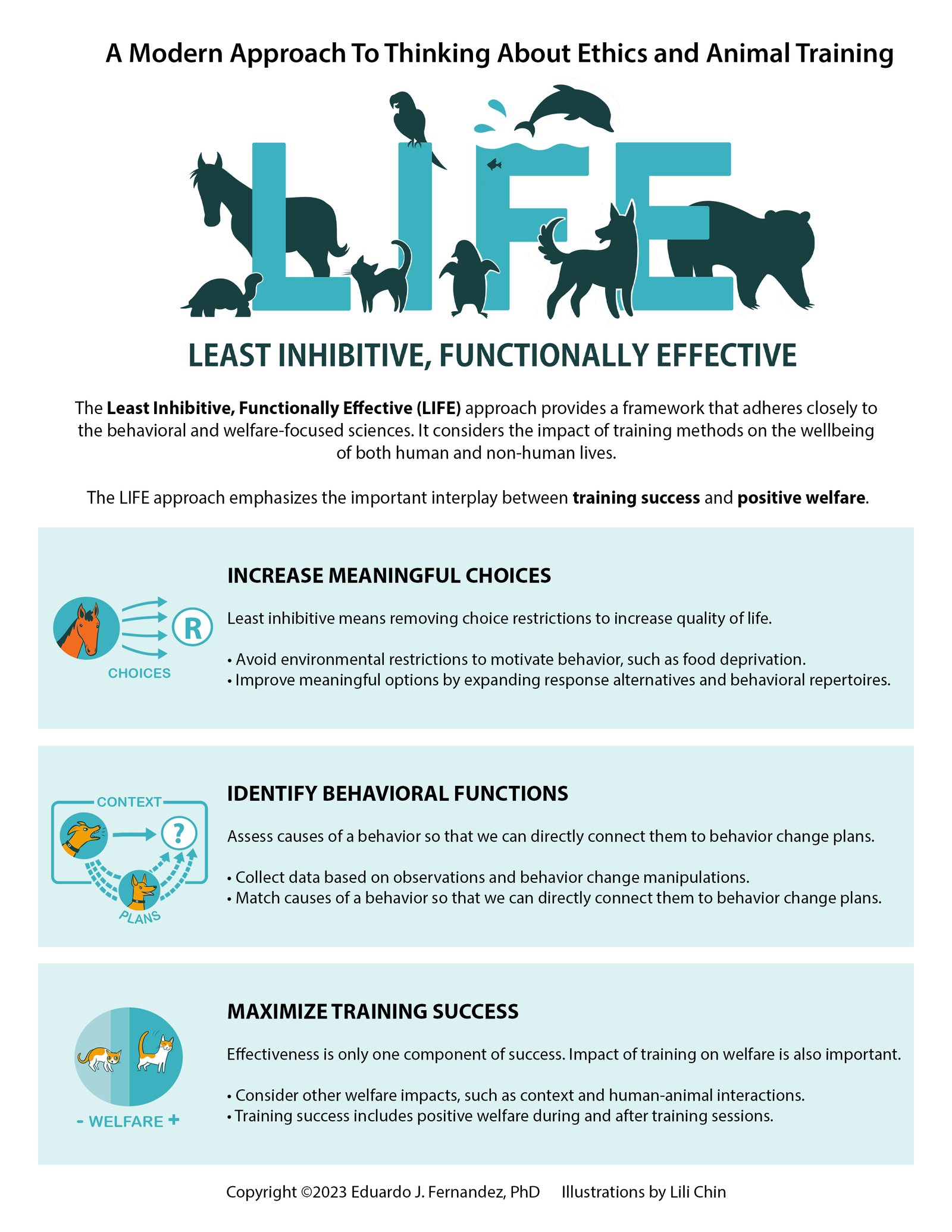
Figura 2. Características críticas del modelo Mínimamente Restrictivo, Funcionalmente Eficaz, incluyendo ejemplos de cómo adherirse al enfoque. Ilustración cortesía de Lili Chin.
Figure 2. Critical features of the least inhibitive, functionally effective model, including examples of how to adhere to the approach. Illustration courtesy of Lili Chin.
La importancia de la función
The importance of function
Un elemento fundamental de muchas ciencias conductuales aplicadas, incluyendo la investigación y la práctica del bienestar animal, ha sido la dependencia de comprender y abordar la función de alguna conducta. En el campo del análisis aplicado del comportamiento, esto se ha realizado típicamente mediante el uso de evaluaciones funcionales del comportamiento (Cooper et al., 2020), que han incluido análisis funcionales (Iwata et al., 1982; Mace, 1994; Hanley, 2012). La característica crítica aquí es que la comprensión de la función de alguna conducta está conectada a nuestros planes propuestos de cambio conductual, de modo que las conductas recién entrenadas puedan cumplir la misma función que las respuestas ofrecidas originalmente. En otras palabras, nuestra capacidad para identificar qué causa alguna conducta significa que también es más probable que la modifiquemos con éxito a través de contingencias apropiadamente emparejadas. Por ejemplo, si un entrenador sabe que un perro obtiene atención por ladrar cuando suena el timbre, puede tanto dejar de dar atención por ladrar en presencia del timbre como, igualmente importante, dar atención por una respuesta alternativa, como sentarse en silencio sobre una alfombra (véase por ejemplo Yin et al., 2008). Las intervenciones como el refuerzo de una respuesta alternativa dependen de emparejar nuestra comprensión de la función con el cambio de conducta: sabemos qué causa la respuesta, por lo que podemos elegir entregar contingencias similares para acciones diferentes. También ilustra por qué enfatizar la importancia de la función en nuestro modelo es imperativo, ya que el conocimiento de la función significa que es más probable que cambiemos la conducta con éxito y de manera ética. Por ejemplo, nos lleva más allá de un protocolo de "simplemente ignóralo", que, en ausencia de reforzar otras conductas, puede no ser de ayuda. La extinción sola no proporciona alternativas funcionales y se ha asociado con conductas problemáticas, como los estallidos de extinción y la agresión (Looney y Cohen, 1982; Lerman e Iwata, 1995).
A cornerstone of many applied behavioral sciences, including animal welfare research and practice, has been a reliance on understanding and addressing the function of some behavior. In the field of applied behavior analysis, this has typically been done through the use of functional behavior assessments (Cooper et al., 2020), which have included functional analyses (Iwata et al., 1982; Mace, 1994; Hanley, 2012). The critical feature here is that understanding of the function of some behavior is connected to our proposed behavior change plans, so that newly trained behaviors can serve the same function as the originally offered responses. In other words, our ability to identify what causes some behavior means we are also more likely to successfully change it through appropriately matched contingencies. For example, if a trainer knows that a dog gets attention for barking when the doorbell rings, they can both stop giving attention for barking in the presence of a ringing doorbell, and just as important, give attention for an alternative response, such as sitting quietly on a mat (for instance, see Yin et al., 2008). Interventions such as rewarding an alternative response are reliant on matching our understanding of function to changing behavior: we know what causes the response, so we can choose to deliver similar contingencies for different actions. It also illustrates why emphasizing the importance of function in our model is imperative, since knowledge of function means we are more likely to change behavior successfully and ethically. For instance, it moves us beyond a "just ignore it" protocol, which, in the absence of rewarding other behaviors, may not help. Extinction alone does not provide functional alternatives and has been associated with problem behaviors, such as extinction bursts and aggression (Looney and Cohen, 1982; Lerman and Iwata, 1995).
Definir el éxito como algo más que ser eficaz
Defining success as more than being effective
La forma en que definimos el éxito debe ir más allá de simplemente ser eficaz (Friedman, 2008). Si solo definimos el éxito de cualquier procedimiento de entrenamiento en función de si cambia o no la conducta, entonces cualquier práctica, ética o no, puede considerarse exitosa. Por lo tanto, la eficacia debería ser solo un componente del éxito del entrenamiento, además de la conexión con la función de la conducta (Van Houten et al., 1988). Podemos pensar en la última parte del modelo LIFE como términos independientemente importantes (es decir, función y efecto), así como esenciales cuando se combinan. En otras palabras:
How we define success needs to be more than simply being effective (Friedman, 2008). If we only define the success of any training procedure by whether it changes behavior or not, then any practice, ethical or not, can be deemed successful. Therefore, effectiveness should only be one component of training success, in addition to connection to the function of behavior (Van Houten et al., 1988). We can think of the latter part of the LIFE model as both independently important terms (i.e., function and effect), as well as essential when combined. In other words:
- función = identificación de la causa
- efecto = cambio conductual (mediante el entrenamiento)
- funcionalmente eficaz = entrenamiento que empareja éticamente el cambio conductual con su causa.
- function = identification of cause
- effect = behavior change (through training)
- functionally effective = training ethically matching behavior change to its cause.
Por lo tanto, ser "funcionalmente eficaz" significa identificar la función conductual y utilizar ese conocimiento para producir un efecto. El éxito del entrenamiento se define tanto por ser eficaz con nuestro procedimiento como por basar dicho procedimiento en la comprensión e implementación de cambios en los eventos causales. Además, es en este punto donde la ética se vuelve crítica: en cómo cualquier procedimiento de entrenamiento considera el efecto del entrenamiento sobre el animal. "Funcionalmente eficaz" también significa cómo el entrenamiento afecta al bienestar general del animal, incluidas las interacciones animal-entrenador. Esto puede y debe incluir todas las consideraciones de bienestar, incluidos los estados afectivos, las historias naturales y la salud física del animal (Fraser, 2008; Novack et al., 2023). El entrenamiento libre de coerción, como filosofía, debe conectarse con nuestra comprensión del bienestar animal, lo que, como resultado, significa tener una mejor comprensión de los animales con los que interactuamos.
Therefore, being "functionally effective" means identifying behavioral function and using that knowledge to have an effect. Training success is defined by both being effective with our procedure and basing our procedure on an understanding and implementation of changes to the causal events. In addition, where ethics becomes critical, is how any training procedure considers the effect of training on the animal. "Functionally effective" also means how training affects overall animal welfare, including animal-trainer interactions. This can and should include all welfare considerations, including affective states, natural histories, and the physical health of the animal (Fraser, 2008; Novack et al., 2023). Force-free training, as a philosophy, should connect to our understanding of animal welfare, which, as a result, means having a better understanding of the animals with which we interact.
Conclusiones
Conclusions
En las últimas décadas, hemos sido testigos de una mayor preocupación por la ética de los procedimientos de entrenamiento animal, lo que probablemente es generado por, y a su vez genera, una investigación continua en entrenamiento animal orientada al bienestar. Nuestro objetivo al impulsar las futuras prácticas éticas de entrenamiento animal debería ser proporcionar modelos que se conecten directamente con la ciencia y la práctica. El nuevo marco LIFE fomenta tal conexión entre las ciencias del bienestar animal y del comportamiento, así como con las prácticas actuales de entrenamiento basadas en recompensas. Otro componente importante del modelo LIFE es depender de una descripción simple pero precisa de las características críticas de las prácticas modernas de entrenamiento animal ético. El acrónimo enfatiza los puntos importantes, incluidos (1) el aumento de elecciones significativas, (2) la identificación de funciones conductuales, y (3) la maximización del éxito del entrenamiento. La parsimonia en el modelo se alcanza manteniendo los conceptos tan simples como sea posible sin sacrificar precisión. Finalmente, la investigación continua debería utilizarse para modificar y expandir cualquier modelo moderno de entrenamiento animal y sus aplicaciones. La teoría y la práctica científicas dependen del cambio regular, y las prácticas éticas de entrenamiento animal deben seguir un camino similar. Depende de nosotros, como científicos y profesionales del bienestar, ajustar nuestro conocimiento del entrenamiento en consecuencia.
In the last few decades, we have witnessed a greater concern for the ethics of animal training procedures, which is likely generated by and generates continued welfare-minded animal training research. Our goal in driving future ethical animal training practices should be to provide models that directly connect to both science and practice. The new LIFE framework fosters such a connection between the animal welfare and behavioral sciences, as well as current reward-based training practices. Another important component of the LIFE model is to rely on a simple yet accurate description of the critical features of modern ethical animal training practices. The acronym emphasizes the important points, including (1) increasing meaningful choices, (2) identifying behavioral functions, and (3) maximizing training success. Parsimony in the model is reached by keeping the concepts as simple yet as accurate as possible. Finally, continued research should be used to modify and expand any modern animal training models and applications. Scientific theory and practice are reliant on regular change, and ethical animal training practices should follow a similar path. It is up to us as welfare scientists and practitioners to adjust our training knowledge accordingly.
Consideraciones éticas
Ethical considerations
Como artículo de revisión narrativa/discusión, no hay aprobación ética que reportar.
As a narrative review article/discussion, there is no ethics approval to report.
Conflicto de intereses
Conflict of Interest
Los autores declaran no tener conflicto de intereses.
The authors declare no conflict of interest.
Referencias
References
- APDT 2017. Position statement on LIMA. Available at: <https://apdt.com/wp-content/uploads/2017/01/position-statement-lima.pdf>. Accessed July 8, 2023.↑1↑1
- Brambell, F.W.R. (Chair), 1965. Report of the Technical Committee to Enquire into the Welfare of Animals Kept under Intensive Livestock Husbandry Systems. Her Majesty's Stationery Office, London.↑1↑1
- Bailey, R.E., Gillaspy, J.A., 2005. Operant psychology goes to the fair: Marian and Keller Breland in the popular press, 1947–1966. Behav. Analyst. 28, 143–159.↑1↑1
- Bihm, E.M., Gillaspy, J.A., Lammers, W.J., Huffman, S.P., 2010. IQ Zoo and teaching operant concepts. Psychol. Rec. 60, 523–526.↑1↑1
- Breland, K., Breland, M., 1951. A field of applied animal psychology. Am. Psychol. 6 (6), 202.↑1↑1
- Broom, D.M., 2011. A History of Animal Welfare Science. Acta Biotheor. 59, 121–137.↑1 ↑2↑1 ↑2
- Browning, H., Veit, W., 2021. Freedom and animal welfare. Animals 11 (4), 1148.↑1↑1
- Capshew, J.H., 1993. Engineering behavior: Project pigeon, World War II, and the conditioning of BF Skinner. Tech. Cult. 34 (4), 835–857.↑1↑1
- Carter, S.L., Wheeler, J.J., 2005. Considering the intrusiveness of interventions. Int. J. Spec. Educ. 20 (2), 136–142.↑1↑1
- CCPDT, 2019. Least Intrusive, Minimally Aversive (LIMA) effective behavior intervention policy. Available at: <https://www.ccpdt.org/about-us/least-intrusive-minimally-aversive-lima-effective-behavior-intervention-policy/>. Accessed July 8, 2023.↑1↑1
- China, L., Mills, D.S., Cooper, J.J., 2020. Efficacy of dog training with and without remote electronic collars vs. a focus on positive reinforcement. Front. Vet. Sci. 7, 508.↑1↑1
- Cooper, J.J., Cracknell, N., Hardiman, J., Wright, H., Mills, D., 2014. The welfare consequences and efficacy of training pet dogs with remote electronic training collars in comparison to reward based training. PLoS One 9 (9), e102722.↑1↑1
- Cooper, J.O., Heron, T.E., Heward, W.L., 2020. Applied Behavior Analysis. Pearson, UK.↑1 ↑2↑1 ↑2
- de Castro, A.C.V., Fuchs, D., Morello, G.M., Pastur, S., de Sousa, L., Olsson, I.A.S., 2020. Does training method matter? Evidence for the negative impact of aversive-based methods on companion dog welfare. PLoS One 15 (12), e0225023.↑1↑1
- de Fernandes, R.C., Dittrich, A., 2018. Expanding the behavior-analytic meanings of "freedom": The contributions of Israel Goldiamond. Behav. Soc. Issues 27, 4–19.↑1↑1
- Domjan, M.P., 2020. The Principles of Learning and Behavior, 7th Edition. Cengage Learning, Boston.↑1↑1
- FAWC, 1979. Five Freedoms. Available at: <https://webarchive.nationalarchives.gov.uk/ukgwa/20121010012427/http://www.fawc.org.uk/freedoms.htm>. Archived from the original on October 7, 2012.↑1↑1
- Fernandes, J.G., Olsson, I.A.S., de Castro, A.C.V., 2017. Do aversive-based training methods actually compromise dog welfare?: A literature review. Appl. Anim. Behav. Sci. 196, 1–12.↑1↑1
- Fernandez, E.J., 2022. Training as enrichment: A critical review. Anim. Welf. 31 (1), 1–12.↑1 ↑2↑1 ↑2
- Fernandez, E.J., Martin, A.L., 2021. Animal training, environmental enrichment, and animal welfare: A history of behavior analysis in zoos. J. Zool. Bot. Gard. 2 (4), 531–543.↑1 ↑2↑1 ↑2
- Fernandez, E.J., McWhorter, T.J., 2023. Who reviews what you do at the zoo? Considerations for research ethics with captive exotic animals. Res. Ethics 19 (4), 419–432.↑1↑1
- Fernandez, E.J., Timberlake, W., 2008. Mutual benefits of research collaborations between zoos and academic institutions. Zoo Biol. 27 (6), 470–487.↑1↑1
- Fraser, D., 2008. Understanding animal welfare. Acta. Vet. Scand. 50 (1), 1–7.↑1↑1
- Friedman, S.G., 2008. What's wrong with this picture? Effectiveness is not enough. Good Bird Mag. 4 (4), 12–18.↑1 ↑2↑1 ↑2
- Gillaspy Jr., J.A., Brinegar, J.L., Bailey, R.E., 2014. Operant psychology makes a splash—in marine mammal training (1955–1965). J. Hist. Behav. Sci. 50 (3), 231–248.↑1↑1
- Goldiamond, I., 1974. Toward a constructional approach to social problems: Ethical and constitutional issues raised by applied behavior analysis. Behaviorism 2 (1), 1–84. <http://www.jstor.org/stable/27758809>.↑1↑1
- Goldiamond, I., 1976. Protection of human subjects and patients: A social contingency analysis of distinctions between research and practice, and its implications. Behaviorism 4 (1), 1–41. <http://www.jstor.org/stable/27758852>.↑1↑1
- Grandin, T., Rooney, M.B., Phillips, M., Cambre, R.C., Irlbeck, N.A., Graffam, W., 1995. Conditioning of Nyala (Tragelaphus angasi) to blood sampling in a crate with positive reinforcement. Zoo Biol. 14 (3), 261–273.↑1↑1
- Hanley, G.P., 2012. Functional assessment of problem behavior: Dispelling myths, overcoming implementation obstacles, and developing new lore. Behav. Anal. Pract. 5 (1), 54–72.↑1↑1
- Harrison, R., 2013. Animal Machines. CABI Publishing, Wallingford, UK.↑1↑1
- IAABC, n.d. IAABC statement on LIMA. Available at: <https://iaabc.org/lima>. Accessed July 8, 2023.↑1↑1
- Iwata, B.A., Dorsey, M.F., Slifer, K.J., Bauman, K.E., Richman, G.S., 1982. Toward a functional analysis of self-injury. Anal. Int. Dev. Disabil. 2 (1), 3–20.↑1↑1
- Johnston, J.M., Sherman, R.A., 1993. Applying the least restrictive alternative principle to treatment decisions: A legal and behavioral analysis. Behav. Analyst. 16 (1), 103–115.↑1↑1
- KPA, 2019. Standards of practice. Available at: <https://karenpryoracademy.com/wp-content/uploads/2019/11/Standards-of-Practice-w_-KPA-Addendum.pdf>. Accessed July 8, 2023.↑1↑1
- Lattal, K.A., Fernandez, E.J., 2022. Grounding applied animal behavior practices in the experimental analysis of behavior. J. Exp. Anal. Behav. 118 (2), 186–207.↑1↑1
- Layng, T.J., 2009. The search for an effective clinical behavior analysis: The nonlinear thinking of Israel Goldiamond. Behav. Analyst. 32, 163–184.↑1↑1
- Lerman, D.C., Iwata, B.A., 1995. Prevalence of the extinction burst and its attenuation during treatment. J. Appl. Behav. Anal. 28 (1), 93–94.↑1↑1
- Lindsay, S.R., 2005. Handbook of Applied Dog Behaviour and Training: Procedures and Protocols Vol. 3. Blackwell Publishing, Ames, Iowa.↑1 ↑2↑1 ↑2
- Looney, T.A., Cohen, P.S., 1982. Aggression induced by intermittent positive reinforcement. Neurosci. Biobehav. Rev. 6 (1), 15–37.↑1↑1
- Mace, F.C., 1994. The significance and future of functional analysis methodologies. J. Appl. Behav. Anal. 27 (2), 385–392.↑1↑1
- McCausland, C., 2014. The five freedoms of animal welfare are rights. J. Agric. Environ. Ethics 27 (4), 649–662.↑1↑1
- McCulloch, S.P., 2013. A critique of FAWC's five freedoms as a framework for the analysis of animal welfare. J. Agric. Environ. Ethics 26 (5), 959–975.↑1↑1
- Melfi, V.A., Dorey, N.R., Ward, S.J., 2020. Zoo Animal Learning and Training. Wiley Blackwell, Hoboken, New Jersey.↑1↑1
- Mellor, D.J., 2016. Updating animal welfare thinking: Moving beyond the "Five Freedoms" towards "a Life Worth Living". Animals 6 (3), 21.↑1↑1
- Mellor, D.J., Beausoleil, N.J., Littlewood, K.E., McLean, A.N., McGreevy, P.D., Jones, B., Wilkins, C., 2020. The 2020 five domains model: Including human–animal interactions in assessments of animal welfare. Animals 10 (10), 1870.↑1↑1
- Mellor, D.J., Reid, C.S.W., 1994. Concepts of animal well-being and predicting the impact of procedures on experimental animals. In: Baker, R.M., Jenkin, G., Mellor, D.J. (Eds.), Improving the Well-Being of Animals in the Research Environment. Australian and New Zealand Council for the Care of Animals in Research and Teaching, Glen Osmond, Australia, pp. 3–18.↑1↑1
- Millikan, D., 2012. Defining, determining and maintaining best practices within our force free organization. Barks Guild 1 (2), 8–9.↑1↑1
- Novack, L.I., Schnell-Peskin, L., Feuerbacher, E., Fernandez, E.J., 2023. The science and social validity of companion animal welfare: Functionally defined parameters in a multidisciplinary field. Animals 13 (11), 1850.↑1↑1
- Patterson-Kane, E., Golab, G.C., 2013. History, philosophies, and concepts of animal welfare. In: Bayne, K., Turner, P.V. (Eds.), Laboratory Animal Welfare. Academic Press, London.↑1↑1
- Peterson, G.B., 2004. A day of great illumination: BF Skinner's discovery of shaping. J. Exp. Anal. Behav. 82 (3), 317–328.↑1↑1
- Popper, K., 1985. Evolutionary epistemology. In: Tarozzi, G., van der Merwe, A. (Eds.), Open Questions in Quantum Physics: Invited Papers on the Foundations of Microphysics. Springer Netherlands, Dordrecht, pp. 395–413.↑1↑1
- Pryor, K., 1984. Don't Shoot the Dog: The New Art of Teaching and Training. Bantam Books, New York.↑1↑1
- Ramirez, K., 2012. Marine mammal training: The history of training animals for medical behaviors and keys to their success. Vet. Clin. Exot. Anim. Prac. 15 (3), 413–423.↑1↑1
- Refsgaard, J.C., Henriksen, H.J., 2004. Modelling guidelines–terminology and guiding principles. Adv. Water. Resour. 27 (1), 71–82.↑1↑1
- Rescorla, R.A., 1969. Pavlovian conditioned inhibition. Psychol. Bull. 72 (2), 77.↑1↑1
- Sidman, M., 1989. Coercion and Its Fallout. Authors Cooperative, Boston.↑1↑1
- Skinner, B.F., 1951. How to teach animals. Sci. Am. 185 (6), 26–29. <https://www.jstor.org/stable/24950550>.↑1↑1
- Skinner, B.F., 1960. Pigeons in a pelican. Am. Psychol. 15 (1), 28–37.↑1↑1
- Todd, Z., 2018. Barriers to the adoption of humane dog training methods. J. Vet. Behav. 25, 28–34.↑1 ↑2↑1 ↑2
- Van Houten, R., Axelrod, S., Bailey, J.S., Favell, J.E., Foxx, R.M., Iwata, B.A., Lovaas, O.I., 1988. The right to effective behavioral treatment. J. Appl. Behav. Anal. 21 (4), 381–384.↑1↑1
- Vollmer, T.R., Hagopian, L.P., Bailey, J.S., Dorsey, M.F., Hanley, G.P., Lennox, D., Roirdan, M.M., Spreat, S., 2011. The Association for Behavior Analysis International position statement on restraint and seclusion. Behav. Anal. 34 (1), 103–110.↑1↑1
- Winett, R.A., Winkler, R.C., 1972. Current behavior modification in the classroom: Be still, be quiet, be docile. J. Appl. Behav. Anal. 5 (4), 499–504.↑1↑1
- Yin, S., Fernandez, E.J., Pagan, S., Richardson, S.L., Snyder, G., 2008. Efficacy of a remote-controlled, positive-reinforcement, dog-training system for modifying problem behaviors exhibited when people arrive at the door. Appl. Anim. Behav. Sci. 113 (1–3), 123–138.↑1↑1
- Ziv, G., 2017. The effects of using aversive training methods in dogs—A review. J. Vet. Behav. 19, 50–60.↑1 ↑2↑1 ↑2